This event has passed.
View All Events
The Senator Nikil Saval Forum
February 9, 2026
7:00 pm — 8:15 pm
On-campus
Event Partners
Current Themes

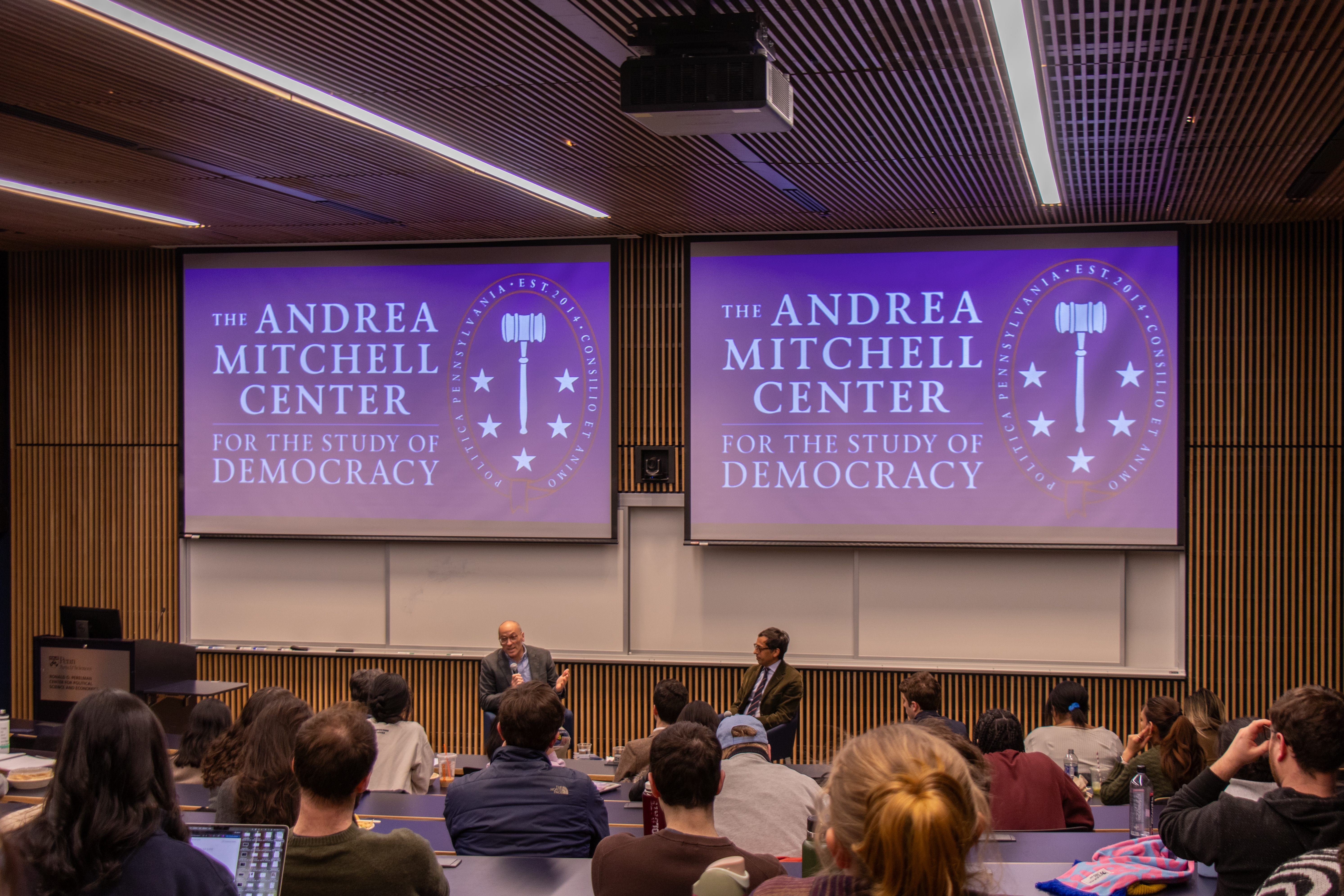
On February 9, 2026, the Penn Institute for Urban Research (Penn IUR), in partnership with the Penn Political Union, School of Arts & Sciences, the Andrea Mitchell Center, and the Department of City & Regional Planning within the Weitzman School of Design, and the Senator Nikil Saval Forum, hosted Pennsylvania State Senator Nikil Saval (First District) for a conversation on housing affordability and urban policy. Moderated by Penn IUR Faculty Fellow Vincent Reina, Faculty Director of the Housing Initiative at Penn and former Senior Advisor for Housing and Urban Policy in the White House Domestic Policy Council, the event explored how the pandemic shifted the housing landscape and what legislative tools are currently being used to keep Pennsylvanians in their homes.
Senator Saval framed the current legislative strategy through the "3 Ps": Production, Preservation, and Protection. He noted that the COVID-19 pandemic fundamentally "colored" the housing conversation by proving that government intervention—such as emergency rental assistance—can effectively prevent displacement.
A centerpiece of the discussion was the Whole-Home Repairs Program. Professor Reina noted this as a rare example of "purple politics," where Saval, a Democratic Socialist, successfully built a bipartisan coalition. By framing housing as a universal issue affecting both urban and rural communities, Saval secured $120 million in state funding and support from seven Republican colleagues. The program "braids" together disparate grants for weatherization and repairs, allowing residents to address multiple deficiencies at once to remain in their homes.
When asked by Reina if there is hope at the federal level, Saval offered a "qualified yes." He pointed to surprising bipartisan momentum, such as the ROAD to Housing Act of 2025—a housing package co-sponsored by Republican Senator Tim Scott of South Carolina and Democratic Senator Elizabeth Warren of Massachusetts. He also highlighted innovative models like Montgomery County, Maryland’s use of subordinate loans for social housing as a potential blueprint for scaling production.
Saval emphasized that for these policies to succeed, there must be a shift in political power. He urged the development of a "renter consciousness," noting that while one-third of Pennsylvanians are tenants, they remain underrepresented in a legislature where many lawmakers are landlords.
The Q&A session addressed the granular challenges of urban living and market equity:
In his closing advice to students, Saval encouraged direct involvement in housing advocacy: "We need more people involved... because we need more people to get housed."

"We need more people involved... because we need more people to get housed."
Providing expert commentary on urban topics and highlighting Penn IUR's research in the context of pressing urban issues.


