This event has passed.
View All Events
Penn Climate Seminar: Dorit Aviv on Rethinking the Future of Cooling
November 12, 2025
12:00 pm — 1:00 pm
On-campus
Event Partners
Current Themes

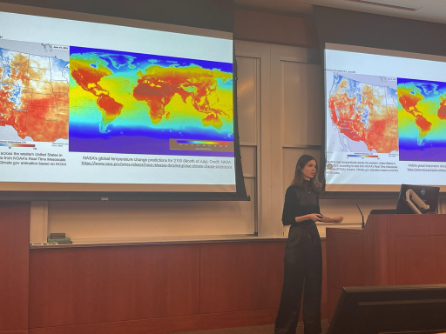
On November 12, 2025, Penn IUR joined Penn Climate to co-host a seminar, "Rethinking the Future of Cooling: Combating Rising Heat without Air Conditioning." In this seminar, Dorit Aviv, Director of the Thermal Architecture Lab and Assistant Professor of Architecture at the University of Pennsylvania’s Weitzman School of Design, discussed an important dilemma in climate adaptation: How can we provide cooling without overwhelming our planet?
As the effects of climate change continue to increase temperatures across the world, cooling technology—dominated by air conditioning technology—has become a necessity, and cooling systems are emerging as one of the fastest-growing energy sectors. At the same time, however, our growing reliance on traditional infrastructure places enormous strain on power grids, making them more vulnerable to failure when demand spikes. Moreover, the closed nature of air-conditioned buildings has emerged as a risk, highlighted by the COVID-19 pandemic.
At the same time, Aviv highlighted the fact that heat is far from evenly distributed and experienced in urban areas. Environmental phenomena, such as the heat island effect and the urban canyon condition (where sunlight is trapped, surfaces absorb heat, and neighborhoods heat up more rapidly), compound heat risks in dense city environments. These risks are often inequitably borne by vulnerable populations—often disadvantaged communities of color face higher exposure to heat hazards and fewer resources for mitigation. Aviv emphasized the need for different forms of cooling that are simultaneously innovative, accessible, and effective, using the examples of projects that the Thermal Architecture Lab has been working on.
The first project discussed is an Adaptive Wind mechanism, known as a Hydroculus Cooling System. Designed for hot and dry climates, this evaporative cooling mechanism features hydrogel membranes and an open-air architecture approach, diverging from the typical closed air-handling blocks found in buildings. Professor Aviv’s lab received the Holcim Foundation Sustainable Awards in 2021 for one of these passive-cooling prototypes while at Princeton.
The second project is a public cooling station that utilizes radiant cooling panels to absorb body heat and reduce surface temperatures, emphasizing open-air pavilions over fully enclosed, air-conditioned structures. This project was formulated as an alternative to community cooling centers, which both rely heavily on the power grid and can be inconveniently located. Such a system works well in hot and humid environments such as Philadelphia, where a pilot project was implemented in the Hunting Park neighborhood. Other projects include developing reflective coatings for urban surfaces to reduce land surface temperature and collaborating with Philadelphia schools to assess how classrooms can be passively cooled while maintaining fresh air ventilation.
Aviv’s seminar underscored the importance of shifting the mindset of “cooling = air conditioning”, as this approach is no longer viable if our goal is sustainability, resilience, and equity. Instead, cooling technologies must be tailored to specific climate contexts (hot/dry vs. humid), building typologies, urban morphologies, and community needs. Furthermore, cooling and ventilation should be conceived together, not just as separate “fresh-air” and “AC” systems, but as integrated design strategies.
Providing expert commentary on urban topics and highlighting Penn IUR's research in the context of pressing urban issues.