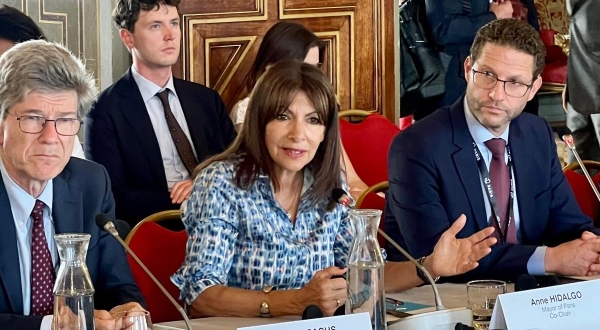
Penn IUR Leaders Advance Urban Climate, Nature Finance Ahead of COP30 Brazil
In the lead-up to COP30, Penn IUR, as Secretariat of the SDSN Global Commission for Urban SDG Finance, participated in high-level convenings across Rio de Janeiro, São Paulo, and Belém, advancing efforts to close the urban climate and nature finance gaps.
Penn IUR joined with Penn’s Perry World House to co-sponsor a welcome reception for global leaders arriving in Brazil for a slate of events, including C40 leaders and 2025 Lawrence C. Nussdorf Urban Leadership Prize winner and Commissioner Yvonne Aki-Sawyerr, mayor of Freetown, as well as Commissioners Kate Gallego, Mayor of Phoenix, Sharon Gil, UNEP City Unit, Lin O’Grady, Deputy Head in EBRD's Sustainable Infrastructure Group, Lord Marvin Rees, former Mayor of Bristol, Mauricio Rodas, former Mayor of Quito and Gulnara Roll, UNEP Head of Cities Unit and Commission Task Force Co-chair.
Birch Highlights Urban Climate Finance at the C40 World Mayors Summit
At the Local Leaders Forum’s C40 World Mayors Summit 2025, hosted by the COP30 Presidency and Bloomberg Philanthropies to unite mayors, governors, and subnational officials, Penn IUR Co-Director Eugénie Birch represented the SDSN Global Commission on Urban SDG Finance on the panel “Climate Finance: Unlocking Urban Investment.” She outlined the Commission’s three-part framework—Country Platforms, City Portfolios, and the Green Cities Guarantee Fund—as tools to help cities mobilize climate finance at scale.
Moderated by Barbara Buchner of the Climate Policy Initiative, the panel also featured leaders from Chefchaouen, Santiago, London, and Amsterdam, emphasizing how cities are innovating green funds, strengthening enabling environments, and building pipelines of bankable climate projects at the local level.
Rodas Underscores Cities’ Role in Meeting Global Climate Goals
Commissioner Mauricio Rodas, former Mayor of Quito, participated in multiple Local Leaders Forum events, including the Urban Transitions Mission Summit and VGMobility’s “Accelerating E-Mobility for Climate Action.” He shared updates on the Green Cities Guarantee Fund and stressed the urgency of scaling city access to finance:
“Without an effective role from cities, countries will not meet their NDCs [Nationally Determined Contributions]. And without proper access to climate finance, cities cannot fulfill that role.”
NDCs are crucial commitments made by countries under the Paris Agreement to reduce greenhouse gas emissions and adapt to climate change impacts.
Lloyd Moderates UNEP “Generation Restoration” Panel in São Paulo
In São Paulo, Amanda Lloyd, Penn IUR Global Programs Director, moderated Panel 5: Financing Climate Action–Nature in Cities at UNEP’s #GenerationRestoration initiative. She highlighted the vast global financing gap for biodiversity and adaptation, estimated at $700 billion to $1 trillion per year, and the limited share reaching cities, particularly for urban adaptation.
Lloyd guided a discussion with leaders from Montreal, Curitiba, São Paulo, and WRI Brazil on how cities can integrate Nature-Based Solutions (NbS) into municipal budgets, diversify revenue sources, and work with financial institutions to scale restoration projects. Panelists shared approaches ranging from Montreal’s eco-fiscal tools and capital budget commitments to Curitiba’s carbon market pilot and São Paulo’s integration of PlanClima into its budget.
Legal Pathways for the Green Transition at COP30
At COP30 in Belém, William Burke-White, a Penn Professor of Law representing the Commission’s Secretariat, spoke at the Thai Pavilion on a panel focused on the Green Transition. He drew on his proposal for a Green Investment Protocol to the United Nations Framework Convention on Climate Change (UNFCCC), first published by the Kleinman Center for Energy Policy, also represented at COP30. Burke-White emphasized the role of international law in de-risking and accelerating green investment, particularly in regions where capital is most needed.
He noted that the rise in private-sector climate finance reflects improved risk-mitigation structures and argued that bilateral investment treaties must be updated to prioritize renewable energy and green technologies.
His central recommendation for a new green treaty framework aims to incentivize and protect climate-aligned investment flows, ensuring that international economic agreements support, rather than impede, the global transition to clean energy.
Strengthening Partnerships for COP30
Across all cities, Penn IUR collaborated with partners, including the Climate Policy Initiative/City Climate Finance Leadership Alliance, as well as global urban policy leaders, to advance practical solutions for subnational climate and nature finance.
As COP30 comes to a close, Penn IUR sought to underscore the essential role of cities in the race to mitigate climate change impacts. Countries cannot meet their climate commitments without empowering cities. Cities, meanwhile, cannot act without equitable access to finance. Accessible, scalable, and well-designed finance will help cities lead effective climate adaptation.