Article
Urban Link
Exploring the Impact of Anchor Institutions
October 21, 2025

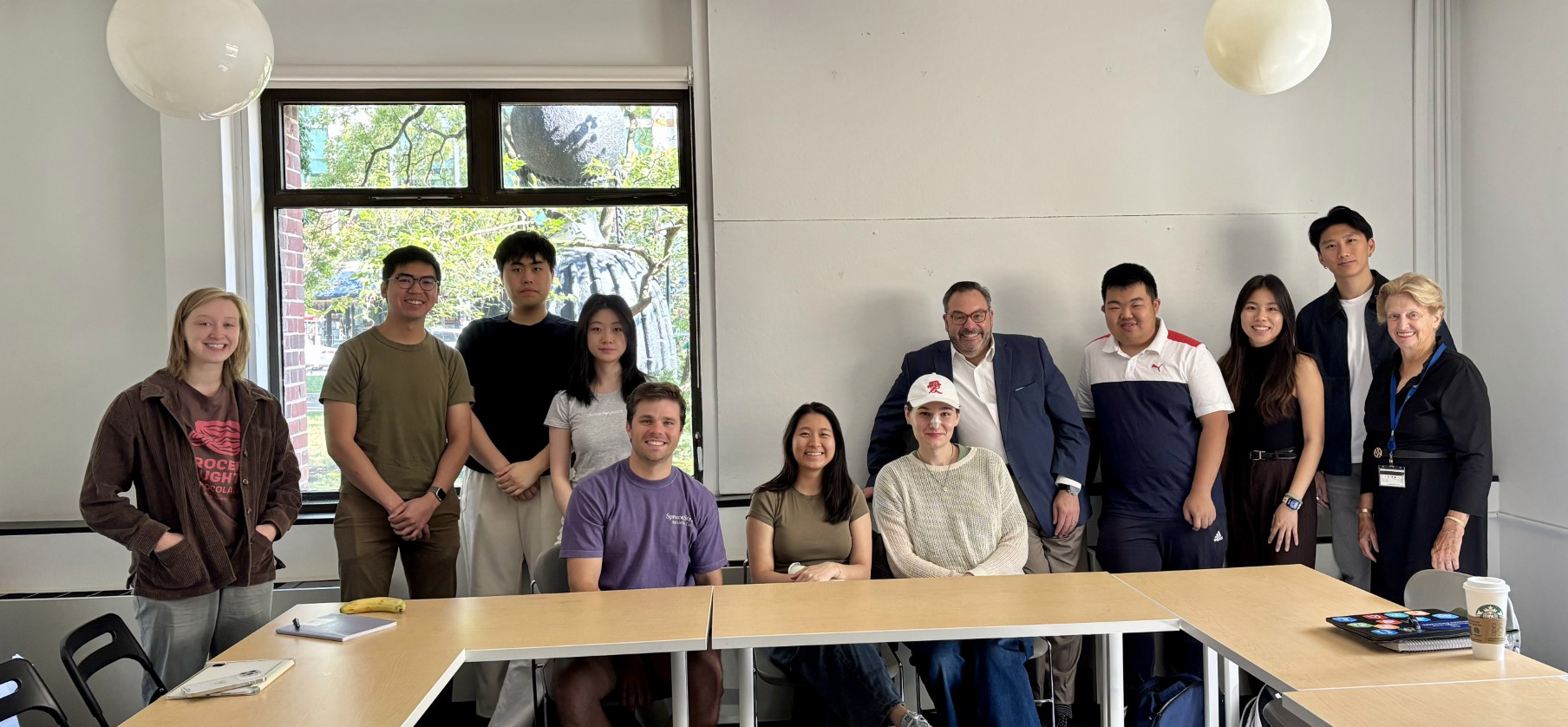
Penn IUR Co-Director Eugénie L. Birch and Tony Sorrentino, former Associate Vice President in Penn’s Office of the Executive Vice President and incoming CEO of the Fairmount Park Conservancy, are offering a graduate course, “Anchor Institutions as Agents of Change: Past, Present and Future,” in The Weitzman School’s Department of City and Regional Planning. The class is reviewing past and present work of all types of anchor institutions and is also concerned with the next steps that such active universities as Penn will be taking in this area.
Anchor institutions, entities having a large stake in a city, usually through a combination of internal missions and land ownership, have important economic impacts due to their employment, revenue-generating, and spending patterns. Consuming sizable amounts of land, they also have a social and environmental presence in cities and their neighborhoods. The label encompasses universities, hospitals, cultural institutions (including museums, libraries, performing arts facilities), churches, military installations, and occasionally large corporations.
Penn has long been a leading anchor institution, recognized widely for its pioneering work in revitalizing West Philadelphia, and now has its role embodied in Penn’s 2024 strategic framework, “In Principle and Practice.” The framework states that “being an excellent Philadelphia neighbor and global citizen is essential to Penn’s mission.”
To explore the implications of this charge, Penn IUR Co-Director Eugénie L. Birch and Tony Sorrentino, former Associate Vice President in Penn’s Office of the Executive Vice President and incoming CEO of the Fairmount Park Conservancy, are offering a graduate course, “Anchor Institutions as Agents of Change: Past, Present and Future,” in The Weitzman School’s Department of City and Regional Planning. The class is reviewing past and present work of all types of anchor institutions and is also concerned with the next steps that such active universities as Penn will be taking in this area. To ground classroom learning in the city’s physical and institutional landscape, Birch and Sorrentino have led students on walking tours of Penn’s 300-acre campus and its surrounds from the Post Office site to 40th Street and the medical district along Civic Center Boulevard, witnessing and discussing how Penn and its partners have transformed the area.
As the course situates the anchor institution model within the broader field of city and regional planning, introducing students to the history of the movement and its evolution across U.S. cities, it has also invited guest experts who include:
Additional speakers include David Asch, Senior Vice President and John Morgan Professor of Medicine at UPenn, who will detail the Penn Forward initiative, and John Grady, Partner and Chief Investment Officer, Wexford Science and Technology, Former President, Philadelphia Industrial Development Corporation, who will discuss West Philly’s emergence as an innovation district.
Throughout the semester, students develop written analyses and group projects that evaluate a real-world anchor institution, culminating in a proposal for a planning initiative centered on social equity, inclusion, and sustainability.
The course is part of a collaborative project, Penn as an Anchor Institution initiative, led by Birch, Sorrentino, Patrick Brennan (Perelman School of Medicine and University of Pennsylvania Health System), and Susan Wachter (Penn IUR and the Wharton School). Penn’s Draw Down the Lightning Grants, which highlight innovative, interdisciplinary teaching and research, and donations from the Penn IUR Advisory Board are supporting the initiative.
A 25-year veteran of Penn and a Master of City Planning alumnus of the Weitzman School of Design, Sorrentino has helped lead the university’s anchor mission from concept to practice. His work includes such major initiatives as the Pennovation Works innovation hub and Penn Park, two projects that have redefined the relationship between campus and city. He also helped organize the Anchor Institution Summit in partnership with Penn IUR and represents Penn on the Anchor Institutions Task Force, which advises the U.S. Department of Housing and Urban Development.
Sorrentino’s forthcoming book, Medicine for the City (Penn Press, 2026), examines how Philadelphia’s health institutions, encompassing Penn Med, the Hospital of the University of Pennsylvania (HUP), and the Children’s Hospital of Pennsylvania (CHOP)—many centered on the site of the city’s former Civic Center—have driven economic growth and reimagined healthcare through strategic investments and public-private collaboration.
Recent events in Philadelphia underscore the urgency of this work, including St. Joseph’s University’s controversial sale of former University of the Sciences buildings and the University of the Arts’ sudden closure, showing how institutional decisions reverberate through neighborhoods and across sectors. Meanwhile, shifts in federal research funding priorities pose new questions about the economic model underpinning urban universities at a time when universities are being asked to demonstrate their value to the public in more concrete ways.
The course highlights how higher education institutions like Penn enrich every sector of our society as engines of innovation, economic mobility, and shared prosperity—real benefits that cut across politics and geography. As journalist Shawn Donnan recently observed, today’s campuses are “where the country’s next industrial transformation is being created.”
Reflecting on the course, Sorrentino says, “What is very satisfying is engaging with the students who are experiencing this type of study for the first time and seeing their responses to the role an anchor plays in society. Their ideas and insights are inspiring.”
By combining theory, practice, and policy analysis, Birch and Sorrentino are preparing the next generation of planners to harness the complex power of anchor institutions, ensuring that cities grow more innovatively, as well as more equitably.
Providing expert commentary on urban topics and highlighting Penn IUR's research in the context of pressing urban issues.


